

How to Reduce Lead Leakage with Click-to-WhatsApp Ads

Written by
WappCloud Team

Post date
26 June 2026
Your ads are working. Your leads aren't arriving. Here's why — and how to fix it.
You've set the targeting. Launched the campaign. The clicks are rolling in. But when you check your CRM, the numbers don't match. Sound familiar?
This is lead leakage — and it's one of the most expensive, invisible problems in digital marketing today.
What Is Lead Leakage, and Why Does It Happen?
Lead leakage refers to the gap between a user who clicks your ad and a lead who actually reaches your sales team. Most businesses assume this gap is small. It isn't.
Here's where leads typically vanish:
- The landing page. A user clicks your ad, hits a slow-loading or mobile-unfriendly page, and bounces before they ever fill a form.
- The form itself. Long, multi-field forms kill conversions. Asking for a name, email, phone, company size, and annual budget in one go is too much friction.
- The follow-up delay. A lead submits a form. Nobody calls for 3 hours. By then, they've moved on — or found a competitor.
- The channel mismatch. You're communicating by email. They prefer messaging. That gap is silently costing you deals.
The painful truth: most businesses lose 40–60% of their paid ad leads before anyone on the sales team even knows those leads existed.
Why Click-to-WhatsApp Ads Are Built for This Problem
Click-to-WhatsApp ads connect your Meta ad directly to a WhatsApp conversation. Instead of sending a user to a landing page, a single tap opens a chat. No forms. No waiting. No friction.
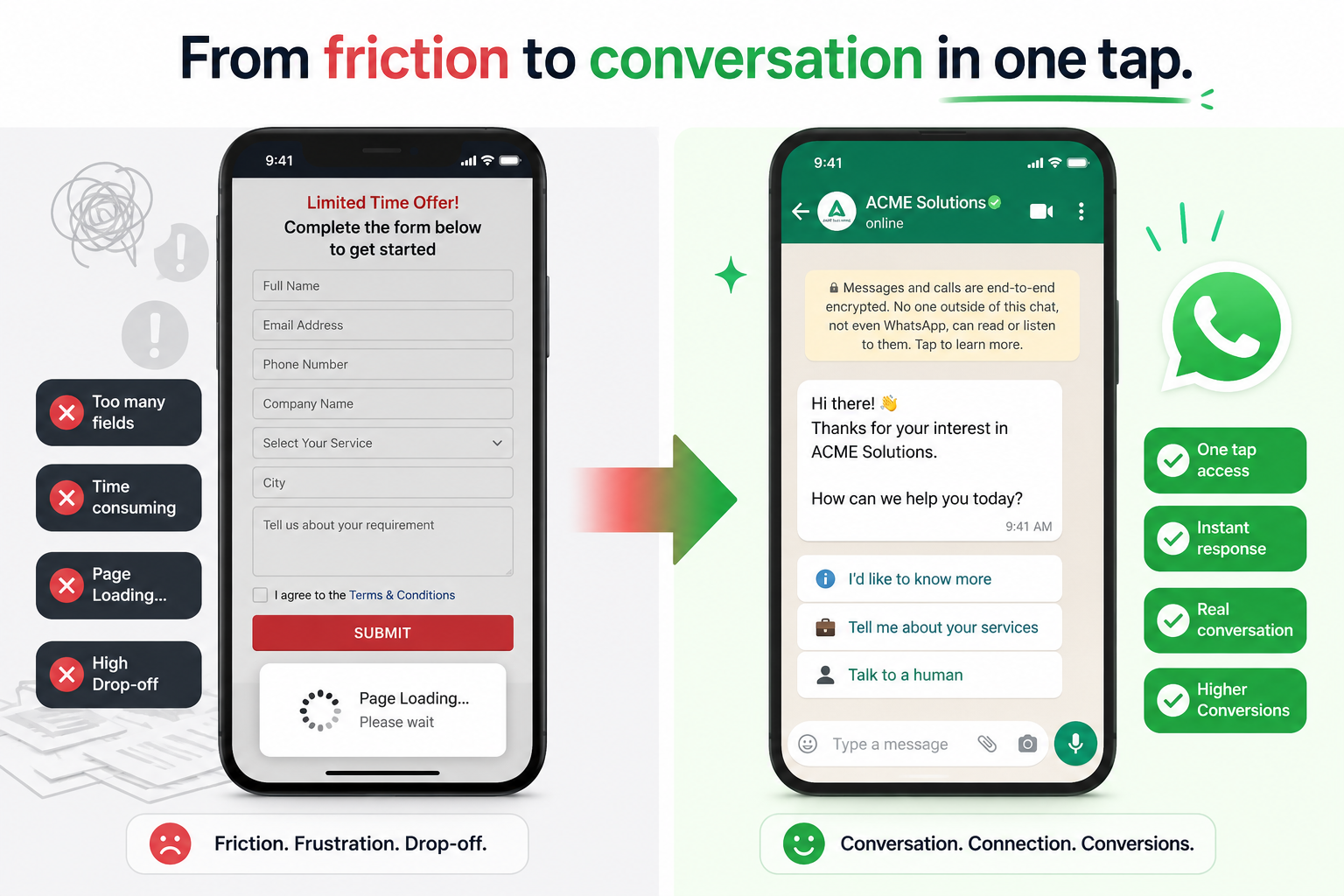
Here's what that changes:
1. Zero landing page drop-off
The user never leaves the platform they're already on. There's no redirect, no page load, no form. The conversation starts immediately.
2. Instant response
Instead of waiting for a salesperson to follow up, an automated welcome message appears the moment the user taps. They're engaged in seconds — not hours.
3. Two-way dialogue from the start
Unlike a form submission, WhatsApp opens a real conversation. You can qualify, answer questions, and move prospects down the funnel — all in one thread.
4. High intent signals
Someone who taps a Click-to-WhatsApp ad and starts a conversation is showing strong intent. They didn't just passively scroll — they acted.
The Lead Leakage Points — And How WhatsApp Closes Them
Let's map each leakage point to the solution:
| Leakage Point | Traditional Ads | Click-to-WhatsApp |
|---|---|---|
| Landing page drop-off | High — slow pages lose users | Eliminated — no landing page |
| Form abandonment | Common — long forms fail | Eliminated — no form needed |
| Follow-up delay | Hours or days | Seconds — automated response |
| Channel mismatch | Email-first, low open rates | WhatsApp — 98% open rate |
| No lead qualification | Form data only | Real-time conversation |
How to Set Up a Click-to-WhatsApp Campaign That Doesn't Leak
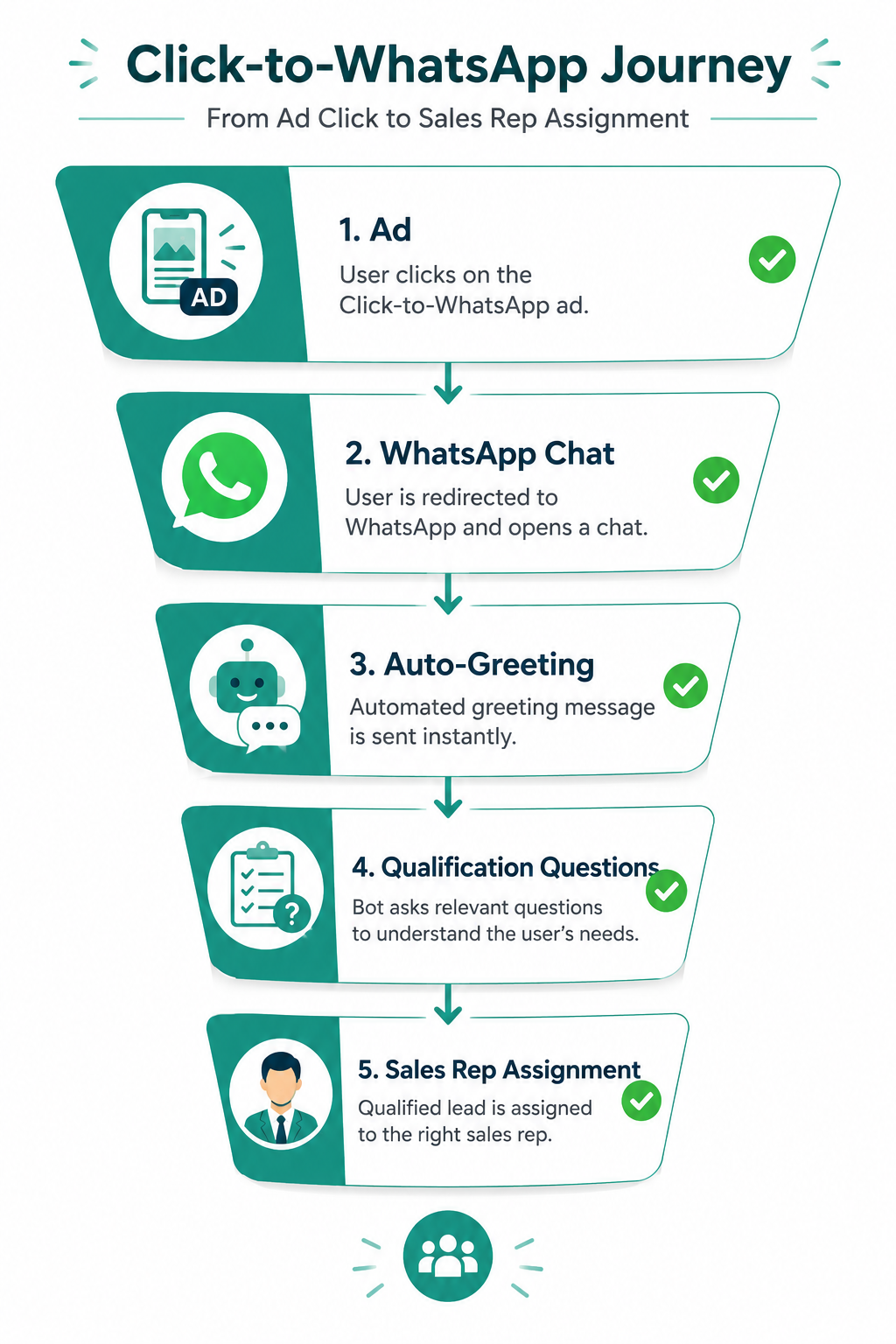
Step 1: Use a strong opening offer in your ad creative
Your ad copy should be direct and promise an immediate value exchange. "Get a free quote on WhatsApp — reply in 60 seconds" works better than a generic "Contact Us."
Step 2: Set up an instant automated greeting
The moment someone taps and lands in WhatsApp, they should receive a message. No dead air. Use a tool like WappCloud to automate this greeting with the user's name and a clear next step.
Example: "Hi [Name]! Thanks for reaching out to us. I'm here to help you right now. What are you looking for today? Just type your question below."
Step 3: Build a quick qualification flow
Don't wait for your team to qualify every lead manually. Build a short automated flow — 2 or 3 questions — that gathers the key information you need. Name, requirement, budget range. Keep it conversational, not form-like.
Step 4: Assign and notify your team in real time
Every qualified lead that comes through should instantly ping your sales rep. WappCloud's routing features allow you to auto-assign incoming chats to the right team member and send internal notifications so no lead sits idle.
Step 5: Track where every lead came from
Use UTM parameters in your ad links combined with WhatsApp conversation tagging to tie each conversion back to a specific campaign, ad set, and creative. You can't fix what you don't measure.
Real-World Results: What Happens When Leakage Stops
When businesses move from traditional form-based ads to Click-to-WhatsApp campaigns, the difference isn't subtle.
Response times go from hours to seconds. Lead qualification happens in the chat automatically. Sales teams receive only pre-qualified conversations, not raw unverified form submissions. And because WhatsApp messages carry a 98% open rate vs. email's 20%, every follow-up message actually gets seen.
Platforms like WappCloud make this entire workflow possible — from auto-greetings and bot flows to team inbox management and campaign analytics. The goal isn't just to capture leads. It's to ensure every single one reaches the right person at the right time.
Lead leakage is a fixable problem. Not with more budget. Not with a new landing page. With a better path from ad to conversation.
Click-to-WhatsApp ads eliminate the friction points where leads disappear. Combine that with the right automation — instant responses, qualification flows, team routing — and you don't just reduce leakage. You close it.
Every click you've already paid for deserves to reach your team. Make sure it does.
Ready to build Click-to-WhatsApp campaigns that convert? WappCloud helps businesses automate their entire WhatsApp sales funnel — from the first tap to the final follow-up.