

The Complete Guide to A/B Testing Your WhatsApp Marketing Campaigns

Written by
WappCloud Team

Post date
16 July 2026
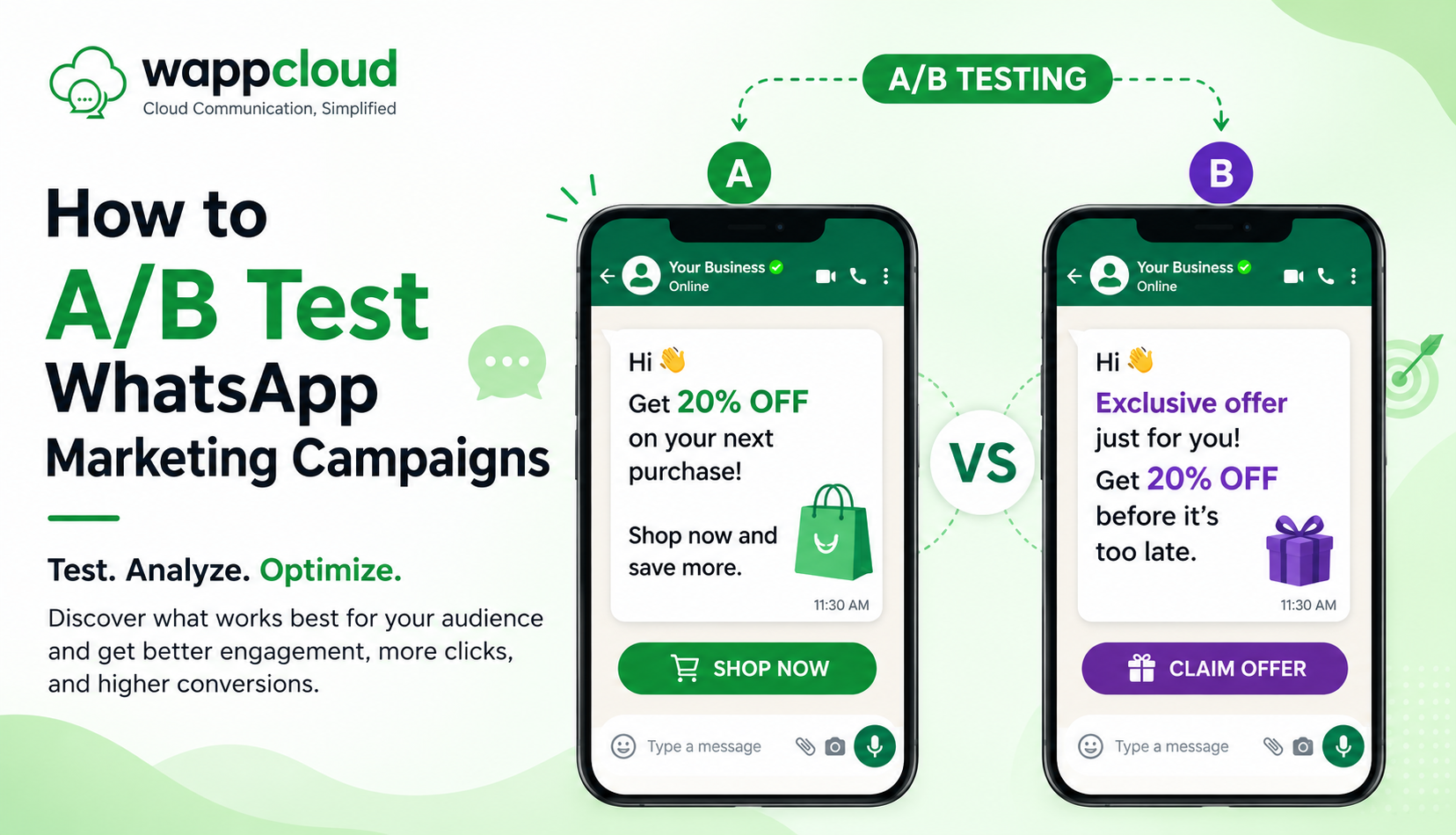
Every day, over 175 million people message a business on WhatsApp. These aren't passive scrolls or skipped ads — they're active, high-intent conversations from customers who are asking questions, comparing offers, and getting ready to buy.
If you're already running WhatsApp campaigns, sending a broadcast is the easy part. The hard part is knowing what actually worked. Was it the opening line? The offer? The CTA? The time you hit send? Guessing costs you money. Testing tells you the truth.
That's exactly what A/B testing solves. This guide walks you through what it is, why it matters, and exactly how to run one — step by step — even if you've never tested a campaign before.
What Is A/B Testing in WhatsApp Marketing?
A/B testing (also called split testing) means sending two versions of the same WhatsApp campaign to two separate customer groups, then measuring which one performs better.
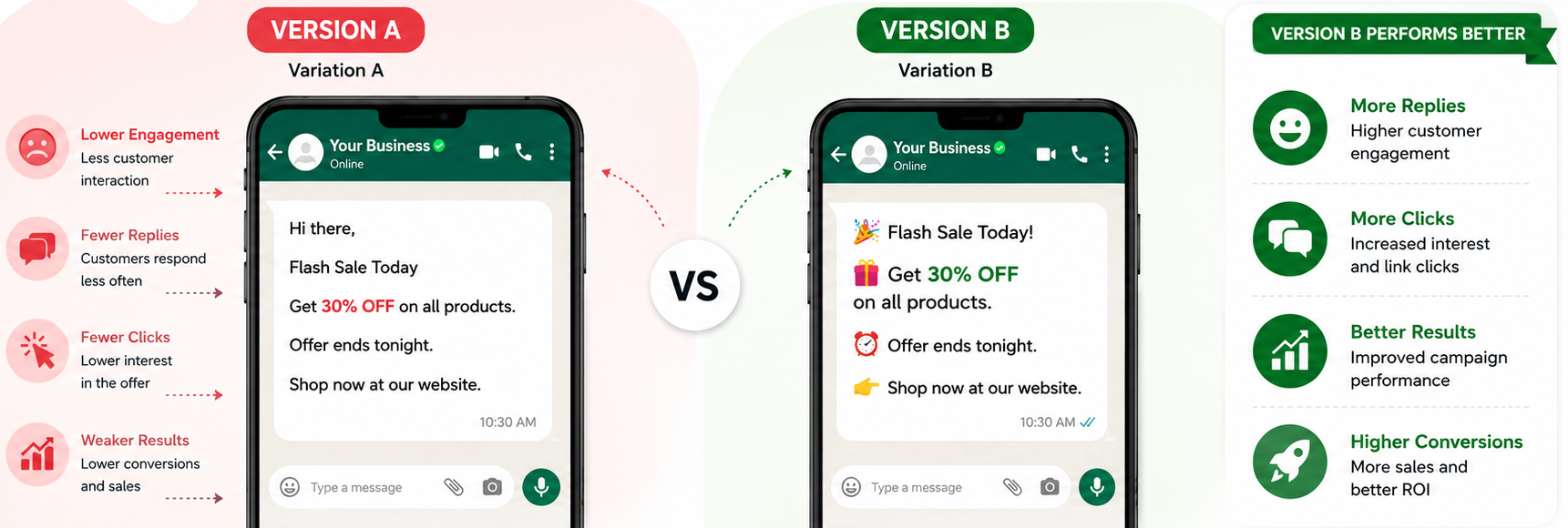
Picture a simple flash sale message. You're not sure which version will land better:
Version A: "Hi there, Flash Sale Today! Get 30% off on all products. Offer ends tonight. Shop now at our website."
Version B: "🎉 Flash Sale Today! 🎁 Get 30% off on all products. ⏰ Offer ends tonight. 👉 Shop now at our website."
Same offer, same audience, different presentation. Send Version A to one half of your list and Version B to the other. After 24–48 hours, compare clicks and conversions. The winner becomes your new default — and the loser still teaches you something.
Why Businesses Should A/B Test WhatsApp Campaigns
WhatsApp already delivers strong engagement out of the box — open rates north of 90% and click-through rates far above email or SMS. But opens and clicks don't pay the bills. Conversions do. Here's why testing is non-negotiable:
Stop wasting spend
Every broadcast has a cost, so testing makes sure that budget goes toward messages that actually convert.
Learn your real audience
Not what worked for someone else's brand, but what your specific customers respond to.
Compound small wins
Even a modest lift in CTR adds up to hundreds of extra conversions at scale.
Replace opinions with evidence
No more "I think we should add emojis" debates — the data settles it.
Maximize ROI
Brands that test consistently see meaningfully stronger returns than those that don't.
What Can You A/B Test?
Almost every element of a WhatsApp campaign can be tested. Focus on these first:
Message Copy
Formal vs. conversational tone, short vs. long messages, storytelling vs. a direct offer, urgency vs. benefit-led language.
Opening Lines
The first line shows up in the notification preview — test question openers, personalized openers, curiosity hooks, and direct-benefit lines.
Call-to-Action (CTA)
"Shop Now" vs. "Claim Your Offer," single CTA vs. two buttons, and CTA placement all move the needle on clicks.
Images and Videos
Product shots vs. lifestyle imagery, static images vs. short video, and clean visuals vs. text overlays.
Personalization
Go beyond a first name — test purchase-history references, segment-specific messaging, and location-based personalization.
Offers and Discounts
Percentage off vs. a flat amount, free shipping vs. a discount, bundles vs. single items, and limited-time vs. evergreen offers.
Send Time
Morning vs. evening, weekday vs. weekend, and pre- vs. post-payday sends can all change open rates.
Audience Segments
The same message can land completely differently with new leads vs. existing customers, or metro vs. tier-2 audiences.
How to A/B Test a WhatsApp Campaign: A 7-Step Process
1. Define One Goal
Before writing a single message, decide what success looks like — more clicks, more bookings, more purchases, or a lower unsubscribe rate. Pick one goal per test.
2. Choose One Variable
This is the rule beginners break most often. A variable is the single thing that changes between Version A and B — the opening line, the CTA, the image, or the offer. Change more than one at a time and you'll never know what actually moved the result.
3. Split Your Audience
Divide your contact list randomly into two similar, equally sized groups. Aim for at least 1,000 contacts per group for results you can trust — 5,000+ is ideal. WappCloud's smart segmentation makes clean, random splits simple.
4. Build Two Versions
Create your control (Version A) and your variant (Version B), changing only the one element from Step 2. Everything else — offer, image, CTA, audience — stays the same.
5. Launch Both at the Same Time
Send Version A and Version B simultaneously. If one goes out earlier than the other, send time becomes a hidden variable and quietly contaminates your results. WappCloud lets you schedule both versions to fire together.
6. Measure Performance
Give the test time to breathe before drawing conclusions:
- Promotional campaigns: 24–48 hours
- Lead-generation campaigns: 48–72 hours
- Re-engagement campaigns: 3–5 days
7. Analyze and Scale the Winner
Declare a winner only when the gap between versions is at least 5–10% and both groups had a large enough sample. Scale it into your next broadcast, document what worked, and use it as the new control for your next test.
Key Metrics to Track
Open rate
Whether your opening line and preview text earn the first tap.
Click-through rate (CTR)
Which message body and CTA actually drive action.
Conversion rate
Which version turns clicks into purchases, bookings, or sign-ups.
Response rate
Which version sparks real two-way conversations.
Unsubscribe / block rate
Which version is quietly annoying your audience.
Revenue per message
Which version moves the needle on actual business results.
A Quick Example
A D2C skincare brand wanted to lift CTR on its weekly promo broadcast. They tested the opening line only, splitting 8,000 existing customers 50/50.
Version A (Control): "Hi {{name}}! Weekend Sale is live. 20% off everything — shop now."
Version B (Variant): "{{name}}, your skin's favourite weekend just started. 20% off, today only."
After 48 hours, Version B pulled ahead on CTR and conversion rate by a wide enough margin to call a clear winner. The brand made it the new control and rolled it into the next five broadcasts — a small copy change, compounding into real revenue over time.
Common A/B Testing Mistakes to Avoid
- Testing multiple variables at once — you'll never know what actually drove the result.
- Ending the test too early — early leaders often flip once the full sample comes in.
- Using too small a sample — a few hundred contacts isn't enough to trust the outcome.
- Testing only once — A/B testing is a habit, not a one-time event.
- Ignoring unsubscribe rates — more clicks mean nothing if you're also losing customers.
- Skipping documentation — without a log, you'll repeat the same tests and the same mistakes.
Best Practices for Successful WhatsApp A/B Testing
- Start with high-impact variables — opening lines and CTAs move the needle most.
- Test on your largest, most engaged segments first for the most reliable read.
- Keep a testing calendar — one variable a month beats random, one-off tests.
- Always start with a hypothesis, then let the data confirm or disprove it.
- Re-test seasonally — what wins during a festival sale may not win in a quiet month.
- Only test pre-approved, compliant templates so nothing gets rejected before it reaches your audience.
Why Businesses Choose WappCloud
Running structured A/B tests manually — splitting lists, scheduling simultaneous sends, and pulling analytics by hand — gets complicated fast. WappCloud is built to make it simple:
- Smart audience segmentation for clean, reliable splits by location, purchase history, tags, and engagement.
- Simultaneous broadcast delivery so both versions go out at exactly the same time, every time.
- Real-time campaign analytics for open rate, CTR, delivery, and response — no manual spreadsheet work.
- Automated follow-ups for contacts who clicked but didn't convert, turning test learnings into revenue.
- Click tracking that shows exactly which link was clicked, by whom, and when.
By pairing automation with disciplined testing, WappCloud helps businesses replace guesswork with data — one campaign at a time.
Ready to improve your WhatsApp marketing campaigns? Start using WappCloud to automate, test, and optimize your WhatsApp campaigns — and help your business engage customers more effectively while driving stronger marketing results.